

Walk into any motorcycle shop and the first tool you reach for on an old motor is a compression tester. It tells you more about a cylinder in twenty kicks than a scope or a bore gauge will in an afternoon. The BETOOLL HW0130 is the kit everyone buys when they do not want to spend a fortune on something they will reach for three times a year. And the 8,700 reviews are not lying about the money. But there is a version of this gauge that the four-and-a-half stars do not warn you about, and it only shows up after you have had it out of the plastic case a few times.
I test compression on everything in this shop, from a little dual-sport with a tired top end to a bagger motor I rebuilt last winter and a small block that visits from the hot-rod side of the building. The BETOOLL has been the first gauge I reach for because it is cheap, it reads, and it has the fittings to reach almost anything. I want to tell you it is a precision instrument. It is not. It is a budget gauge that does a job a more expensive one does, about eighty percent as well, and that last twenty percent is exactly where the low-star reviews live.
The Quick Verdict
A genuinely useful budget gauge that reads close enough for diagnosing a cylinder, as long as you tighten every fitting twice and learn to read a needle that bounces.
Amazon Check Today's Price →The Budget Gauge That Reads Every Cylinder in My Shop
One compression reading settles the argument about a rough-running motor before you order a single part. The BETOOLL HW0130 is the cheap kit I reach for on builds. Check the current price before you tear into a motor blind.
Amazon Check Today's Price on Amazon →How I've Used It
The kit lives in the drawer under the bench, not in its plastic case, because that case is not where you want it to stay. There are eight pieces in the box: the gauge with its long rubber hose, a threaded push-in adapter, and a set of plug adapters and reducers to match the thread sizes you actually run into. On a motorcycle that means the standard 14mm and 12mm plug threads, and on the hot rod it reaches the larger plugs with the right adapter threaded on.
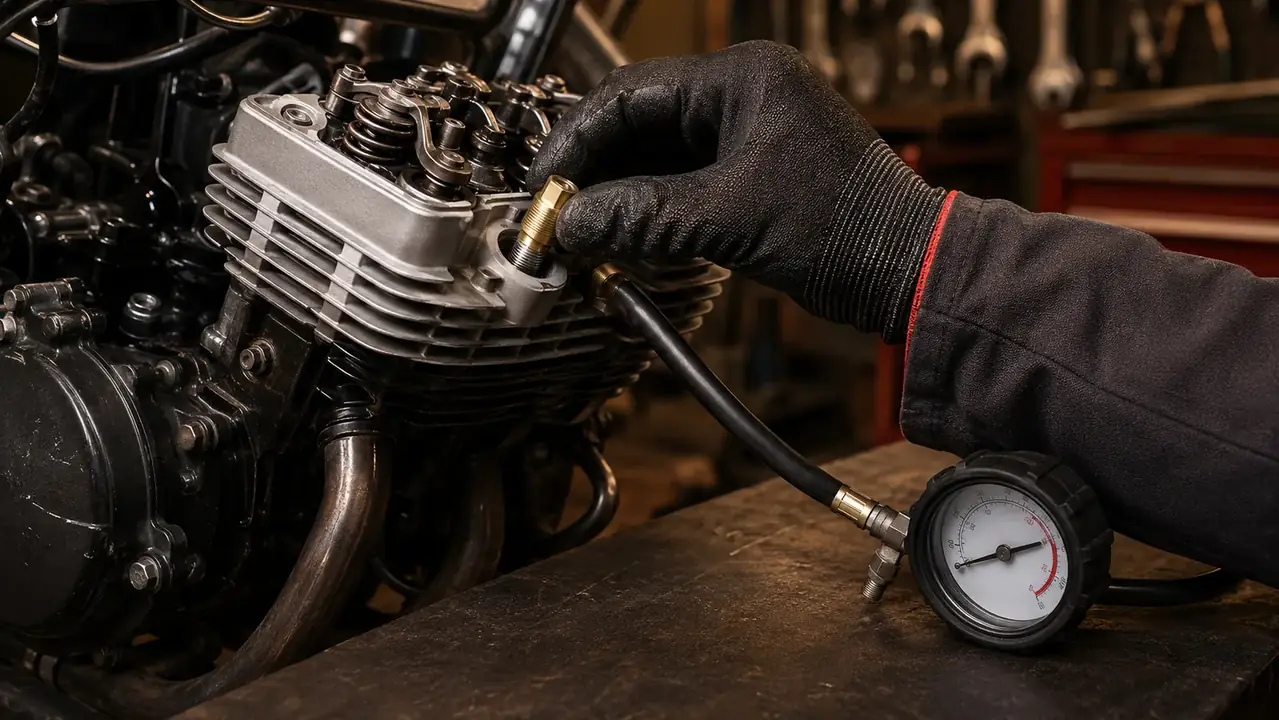
To use it you pull the plug, thread the hose into the hole by hand, open the throttle all the way, hold the kill switch off, and kick or crank until the needle stops climbing. On a battery bike you hit the starter in bursts until the gauge falls still, usually after four or five good revolutions. On a kick-start motor you need every kick you have got. It reads in both psi and bar on the same face, which saves me the math on metric bikes, and the gauge has a small button on the side that holds the peak reading so you can pull the hose and read the number after you stop cranking.
Here is the honest part. The cheap all-thread fitting that screws into the spark plug hole works, but it is the weakest link in the whole kit. The threads are a little loose and the collar that holds the fitting can work loose under the vibration of cranking a big cylinder. If you do not have it snug, you are not reading the motor, you are reading your own bad handshake. I have learned to snug the fitting, then give it one more turn, and to check the collar again before I trust a number. Do not skip that and marvel at a low reading. It will fool you.
I keep a running log of every reading on the whiteboard over the bench, and that habit is where the BETOOLL earns its keep for me. When I test a motor in the fall, write down each cylinder, and retest in the spring after it sat all winter, the comparison tells me more than any single number ever will. If a cylinder dropped twenty psi over the off-season while the others held, that is a diagnosis with a timeline, not a hunch. The gauge gives me the numbers, and the notebook turns them into a story.
The Needle That Bounces
Get the BETOOLL gauge on a healthy cylinder and the needle does not sit still. It climbs, and because it is a cheap mechanical movement with no damping, it rides the pulses of the motor instead of settling on a clean number. On a single-cylinder bike the bounce is constant and you are guessing whether the real reading is the high point, the low point, or somewhere in between.
If you have ever wondered why a branded gauge costs three times as much, this is most of the reason. A damped movement settles, so you read the number once and move on. The BETOOLL makes you watch the swing for a few seconds and pick the average. After a season of using it I treat the reading as a band, not a single number. If the needle hangs around 145 to 155 psi on a motor that spec says should be near 150, that is a pass. If it swings between 90 and 130, that is not a bounce, that is a worn cylinder telling on itself.
That band-reading habit is worth repeating because it is the difference between a good experience with this kit and a bad one. I have watched guys throw the BETOOLL back in the box after one confusing reading, convinced the tool is junk, when the real problem was that they expected it to behave like a lab instrument. It is a mechanical tire-gauge cleverness level. You learn to read the swing, you take the center of the band, and you move on. Once you stop fighting that, the tool stops disappointing you.
There is also the stick. Because it is a mechanical pointer riding a cheap pivot, the needle can hang on the way down and hold a number that is higher than the motor is really putting out. I have caught it reading a full ten psi high on a tired cylinder right after it sat at a high mark from the previous test. Tap the gauge face gently before you trust a reading, the way you would an old analog meter, and let it drop before you start the next cylinder. It is a two-second habit that keeps a low-cost gauge honest.
It is a budget gauge that does a job a more expensive one does about eighty percent as well, and that last twenty percent is exactly where you have to know the tool before you trust its number.
The Leak That Turns a Wet Test Into a Guessing Game
The one thing that can really bite you with this kit is the wet test. When you are trying to decide between rings and valves, you squirt a little oil in the cylinder and retest. If the number jumps way up, it is the rings. If it barely moves, it is the valves. It is the classic diagnostic, and it is where a leak in the tester will fool you completely.
Because the BETOOLL fittings seal with threads and friction instead of a proper O-ring, oil finds its way past them. I have done wet tests where the number barely moved and I was ready to pull the head, and then I found the collar on the adapter was loose and oil was weeping out past it the whole time. The reading was garbage and I almost rebuilt a perfectly acceptable motor on top of a bad seal. If you do the wet test, tighten every fitting twice, wrap a rag around the adapters, and watch for damp. If you see any weep, stop, reseat it, and start over. A wet test only means something if the tool is sealed.
Here is the tell I look for before I trust any wet-test number on this kit. If the dry reading is low and the wet reading jumps by twenty-plus psi, rings are the suspect, and the numbers line up with what I expect. But if the wet number crawls up by only a few psi and still sits low, I do not trust that verdict until I have rechecked the seal on the adapter. The BETOOLL is prone to a false valve verdict on a leaky install, and that is the single most expensive mistake this tool can point you toward, because it sends you at the valves when the rings are the real wear.
The plastic case deserves its own mention because it is the thing reviewers pick at first and it really is the least of the kit's problems. It is a blow-molded tray that holds the gauge and adapters in molded pockets, and the lid does not latch with any authority. It pops open in a drawer or a toolbox, and the gauge rattles against the plastic and chips its paint. That is cosmetic damage, not functional, and I stopped caring the day I left the kit loose in the drawer instead of fighting the case. Judge it on the reading, not the box it rides to the job in.
Where the Hose Falls Short
The gauge hose is a single piece of rubber about a foot and a half long, with the gauge permanently on one end and the threaded fitting on the other. That is plenty for a motorcycle because you can rest the gauge on the frame or a towel over the tank while you crank. But it limits you on a vee engine or a big block where the plug hole sits deep and awkward. On the hot rod, the hose barely reaches a front cylinder with the gauge laid across the inner fender, and on some inline fours the gauge wants to hang over the top of the motor where it is in the way.
The shorter the reach, the more you are holding the gauge by hand while you crank, which fights the needle bounce and makes a steady reading harder. My fix is a second set of hands or a rolled rag under the gauge so it stays put without me holding it. It is not a deal breaker on a motorcycle, which is the machine this kit was really built for, but know going in that the hose is on the short side and plan your spot before you start cranking.
A detail that does not get enough airtime is where you rest the gauge while you crank, because on a motorcycle the tank is right there and you do not want a steel-backed gauge bouncing off your paint. I lay an old shop towel over the tank before I start, both to protect the finish and to give the gauge a place to sit. Small setup habits, but they are what make a short-hose gauge tolerable.
Where It Genuinely Earns Its Keep
For all the picking, the BETOOLL is a good tool for what it costs, and I mean that. On a healthy four-stroke the readings land within a few psi of what a reputable damped gauge shows, which is plenty of accuracy for diagnosis. You are not doing a leakdown test with this thing and you are not certifying a race motor. You are asking one question: is this cylinder in the ballpark or is it not? The BETOOLL answers that question correctly every time I use it correctly, and that is what a diagnostic tool is supposed to do.
The fitting coverage is the other real strength. Eight pieces gives you the adapters to hit a carbureted single, a modern twin, an inline four, and typical car plugs without a trip to the parts store. On a motorcycle you will almost never need more than the kit provides, and having the right adapter in the tray is the whole reason a dedicated compression kit beats borrowing a gauge that only has one thread size. For the price you are paying for that convenience, and it is hard to argue with it.
The peak-hold button is also better than I expected on a gauge this cheap. It catches and holds the high reading so you can pull the hose and read the number without holding pressure, which is exactly how every compression test should end. On a kick-start bike it is worth the money by itself, because you cannot hold the starter and read a bouncing needle at the same time. It is the one feature that keeps me reaching for the BETOOLL over a more expensive gauge I own, for the jobs that fit its reach.

The Tradeoffs Worth Knowing
The BETOOLL is a mechanical gauge, and that is both its strength and its limit. No electronics, no battery, nothing to calibrate beyond trusting the spring and the pointer. Drop it and it still reads, which is more than you can say for the digital kits that get finicky with cold weather and dead cell batteries. The downside is the bounce and the stick I already talked about, which you trade for that durability and the entry price.
Cold versus warm is another thing the kit does not manage for you. A cold motor reads lower than a warm one because the rings are not seated and the oil is thick, so if you compare an overnight-cold reading against a spec that assumes a warm motor you will chase a ghost. I test cold for consistency, note the motor temperature on the whiteboard, and compare like for like. The gauge is honest, but it will not hold your hand.
The closest thing I would put up against it is the DAYUAN kit, which sells at a similar price and covers similar ground. The DAYUAN has a better case and its fittings seal a little more positively, but the BETOOLL has a longer hose and, in my hands, a steadier gauge. If you want the full point-by-point on threading, hose reach, and which reads truer on small engines, I broke it down in my BETOOLL vs DAYUAN comparison. For a shop that just needs a dependable reading on motorcycles and small four-cylinders, the BETOOLL is the one I keep grabbing, finicky hardware and all.
What I Liked
- Cheap enough that it lives in the drawer instead of the locked box
- Reads within a few psi of a proper damped gauge on healthy cylinders
- Eight-piece kit has the adapters for singles, twins, fours, and most car plugs
- Peak-hold button catches the reading so you do not fight the needle
- No battery, no electronics, no calibration, tough enough to drop
- Reads psi and bar on the same face
Where It Falls Short
- Gauge needle bounces and can hang, so you read a band not a number
- All-thread adapter and collar can work loose under cranking vibration
- Fittings can weep oil and wreck a wet test if not tightened twice
- Plastic case pops open and the gauge rattles and chips inside it
- Short hose barely reaches deep or awkward plug holes
Who This Is For
If you wrench on your own motorcycle, the BETOOLL HW0130 is a no-brainer. It is for the guy who has a bike that runs rough or burns oil, who wants to know in an afternoon whether it is rings, valves, or a stuck lifter before he pulls the top end. It is for the builder doing a first start after a rebuild, who wants to confirm every cylinder is up before he fires it and hopes. And it is for the hot-rod guy who wants a cheap second opinion on a used motor he is thinking about buying. A compression reading is the cheapest insurance you can put on a used engine, and this kit makes that reading cheap to get.
If you are the kind of shop that does this weekly, you will probably want a damped gauge with a longer hose and proper O-ring seals, and I would not argue with that. But for the rest of us, the ones who pull the tool out three or four times a season, the BETOOLL is the right answer. You learn its two habits, you tighten the fittings and tap the face, and it tells you the truth. That is all a diagnostic tool owes you.
Who Should Skip It
Skip it if you do not like learning a tool's quirks. If you want a gauge you screw on and read with zero interpretation, buy a damped mechanical gauge or a proper digital kit and pay the difference. The BETOOLL asks you to average a bouncing needle, reseat a loose collar, and double-check for a weep on a wet test, and if that sounds like more trouble than the money saves, this is not the kit for you.
Skip it too if you are doing leakdown testing or chasing a precise number on a race motor. This is not a precision instrument, and pretending it is will cost you more in misdiagnosis than you saved on the gauge. For those jobs I reach for the better tool and leave the BETOOLL for the day-to-day pass-fail checks it was built for. Match the tool to the job, tighten the fittings twice, and you can trust the reading. Skip the tightening, and you will be the guy writing a one-star review about a tool that sealed fine for everyone else who read the instructions.
Know What the Motor Is Telling You Before You Spend on Parts
One cheap reading stops you from tearing down a good top end or ordering parts for the wrong problem. The BETOOLL HW0130 has paid for itself a dozen times in this shop, finicky hardware and all. Check today's price on Amazon and put a real diagnostic on your bench.
Amazon Check Today's Price on Amazon →