
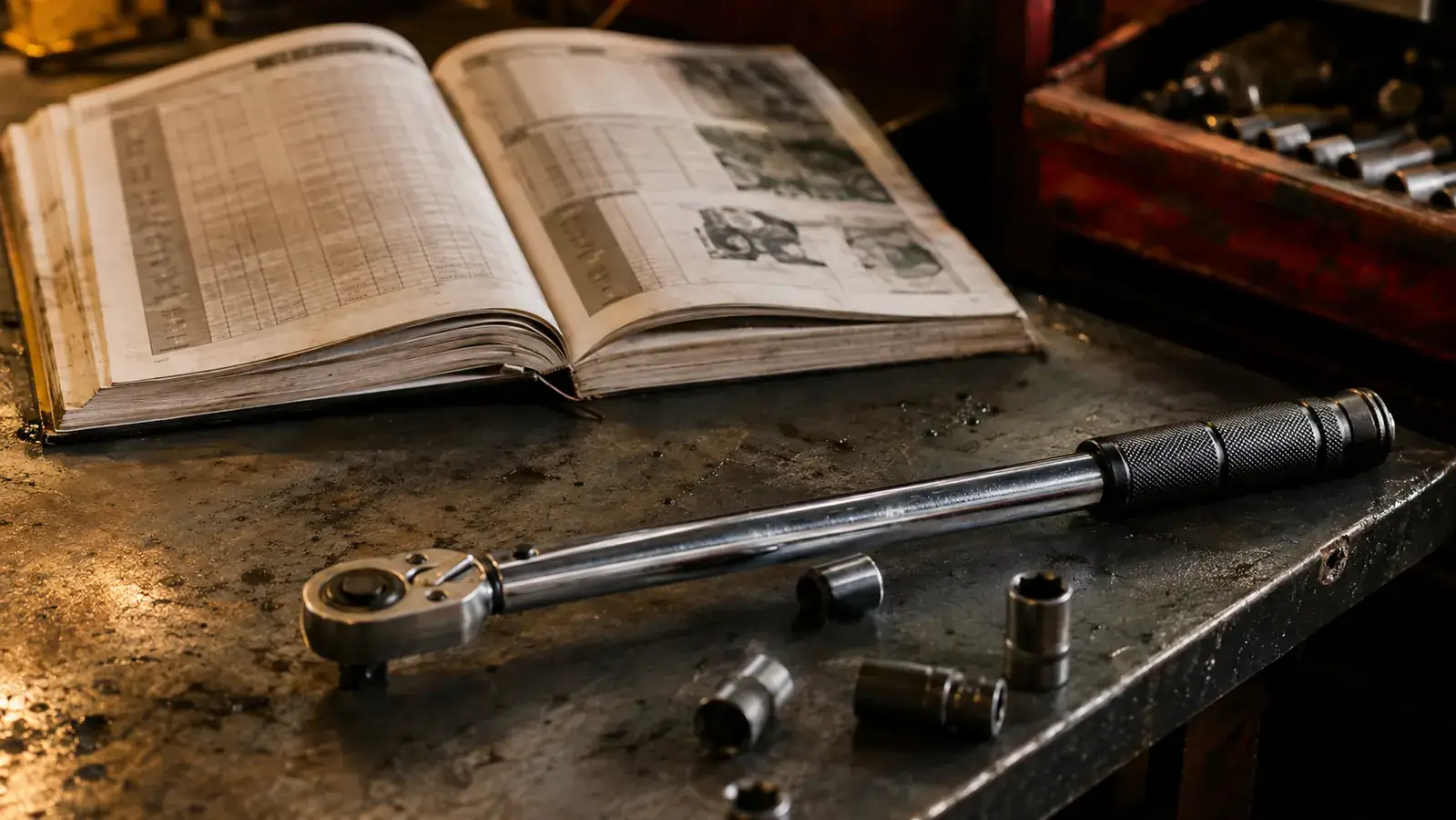
I read the reviews before I bought my LEXIVON LX-183, same as you probably did. Forty thousand of them, almost all five stars, all saying the same three things: it clicks, it's accurate, it's a bargain. All of that is true. What those reviews do not do is tell you how to actually live with a click torque wrench, where this one gets it genuinely wrong, and the habits that decide whether it stays accurate for a decade or drifts in six months. I have had mine on my bench for long enough to find out the hard way, including the mistake most people never admit to.
The quick version: it is a good wrench, the best value 1/2-inch click I have used, and I reach for it on nearly every fastener with a number in the manual. But it is not five stars. It is a four-and-a-half that earns the extra half only if you treat it like the calibration instrument it is. Drop it once off a workbench onto concrete, and that rating needs to come with an asterisk until you verify it.
The Quick Verdict
The LEXIVON LX-183 is a genuinely good click wrench and the best value in its range, but it is a tool that demands a habit: wind it to zero when you hang it up, never use it to break a bolt loose, and re-check it after any drop. Respect that and it will serve you for years. Ignore it and a cheap wrench can drift just as fast.
Amazon Check Today's Price →The click is only as honest as the habit behind it.
The LEXIVON LX-183 is the wrench I trust on every fastener a manual puts a number on, provided I do my part storing it right. Check today's price on Amazon and decide if it earns your bench.
Amazon Check Today's Price on Amazon →Why 40,000 Reviews Only Tell You Half the Story
Go read those five stars and you will see the pattern. Most of them were written in the first month, by people who torqued a lug nut or an engine cover a handful of times and shipped it. That is not a bad review, it is just an incomplete one. A click torque wrench does not reveal its character in a month. It reveals it after a winter on a cold pegboard, after a drop, after the hundredth time you forget to back the collar to zero and leave the spring sitting loaded all night.
The other thing the reviews miss is the shape of the job. Nearly every motorcycle build spends most of its time on small fasteners, the 6mm and 8mm aluminum hardware that lives down at ten to thirty foot-pounds. That is exactly the part of a 1/2-inch wrench's range where cheap mechanisms get vague. So the question that matters is not whether the LEXIVON clicks, it is whether it clicks honestly down where the little bolts are. That is what I actually tested.
I should also say where I am coming from, so you can judge the weight of all this. I wrench for a living and on my own bikes, and I have torqued everything from a 6mm cam cap to big-rig lug hardware. I used to work on an old inline four that had a stripped crankcase thread from a prior owner who trusted feel over the book. That one lesson cost me a helicoil kit and an afternoon, and it is why I do not guess at a number any more. When I say this wrench earns its spot, I am coming at it as someone who has paid the price for doing it wrong.
The Click Feel, Broken Down Like It Ought to Be
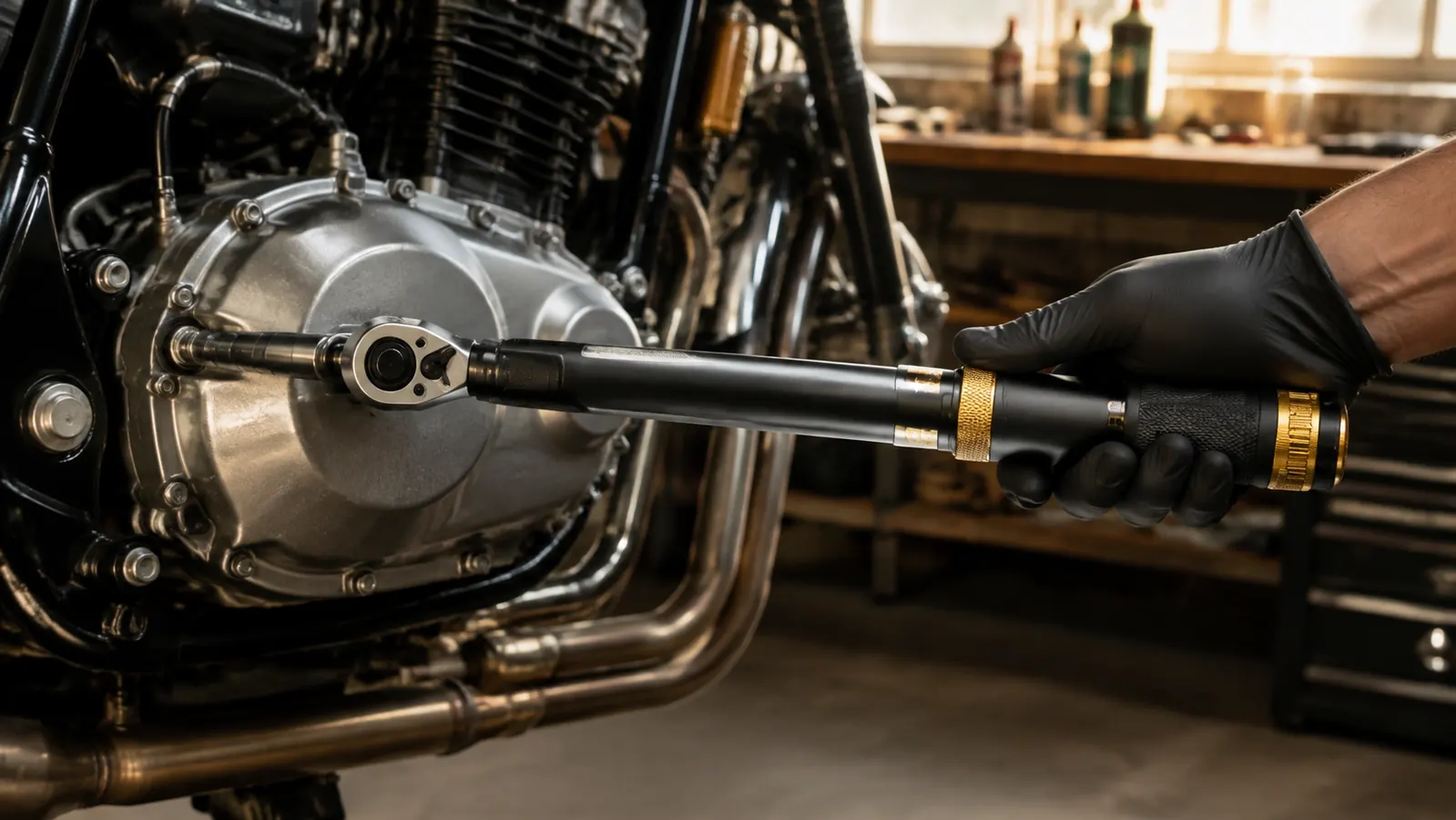
The click on the LX-183 is the reason it sells as well as it does. It is a firm mechanical release you feel in your hand as much as hear, with none of the soft mush you get from the cheapest wrenches. When you are seated on a thin cover gasket and the click lets go, you stop instantly, and that instant is the whole job. I have pulled it on clutch covers, cam caps, and oil pan bolts more times than I can count, and the release has not changed character in the time I have owned it. That consistency is the thing no spec sheet captures.
The collar is knurled and turns with a clean detent between settings, which matters more than people think, because a collar that clicks solidly into place stops you from landing four foot-pounds off just by bumping it. The reversible ratchet head engages cleanly and has not gone sloppy the way budget ratchets do. Pull the handle hard at the top of the range and it still feels solid in a gloved hand rather than flexy.
There is a real difference between how this wrench clicks and how a twenty-dollar one clicks. On the cheap ones the release is soft, so on a gasket you tend to push a fraction past the click before your brain catches up, and that extra fraction is what warps a cover over a sealing surface. On the LEXIVON the release is clean enough that the stop is simultaneous with the click. You do not have to anticipate it or brace for it. It just stops, which saves you from laziness creeping in bolt by bolt when you are doing fifteen fasteners in a row.
I dropped mine off the bench onto concrete once, and the honest truth is I did not trust it again until I verified it against my beam wrench and a known weight.
The Drop: The Failure Mode Nobody Warns You About
Here is the part I want you to hear, because it is the thing that makes an otherwise good wrench a liability if you are careless. Any mechanical click wrench, this one included, is a calibrated instrument. Drop it hard enough onto a concrete floor and the internal detent can shift, and it will start clicking at the wrong number without looking any different. There is no gauge on the side that tells you it lied. You will torque a head bolt, hear the click, and have no idea the setting has drifted four foot-pounds.
I know this because I have done exactly that. Mine took a fall off the workbench, and I had no way to know whether two winters and that bounce had it clicking true. So I checked it. I hung a known weight on a test bolt at a couple of middle settings and compared the click to my beam wrench. It was within a click. But the habit is the point: after any drop, or any hard knock, verify the thing. A torque wrench is not a hammer. Treat a drop as an event that voids your trust until you prove otherwise.
The ground rule is the one I learned on that old inline four and never forgot. Never use a click wrench to break a fastener loose. That job belongs to a breaker bar, because yanking on the handle to unstick a rusty caliper bolt torques the mechanism in a direction it was never meant to take, and that is how a wrench quietly goes out of calibration. If you want a click wrench to stay honest, it only ever turns the tightening direction and it only ever applies steady pressure. This is not specific to the LEXIVON, it is true of every mechanical click wrench ever made, but it is the rule people skip most.
The other habit that keeps the calibration honest is one the manual mentions and almost nobody does: wind the collar back to its lowest setting when you are done. A click wrench works off a spring, and if you leave it set high the spring sits under load twenty-three hours a day, month after month. That is the slowest possible way to wear out the one mechanism that defines the tool. Backing it to zero when it goes on the pegboard is a five-second move that costs nothing and it is the single biggest thing you can do to make a cheap wrench act like an expensive one for years.
The Low End Is Where Budget Wrenches Stumble
This is the part of the LX-183 that genuinely separates it from the pack, and the part I want you to hear because it is easy to miss. A lot of cheap 1/2-inch click wrenches are only trustworthy in the upper two-thirds of their range. Below about thirty or forty percent of the scale they get vague, the click softens, and you are back to guessing. The LEXIVON stays firm down into the teens, which is precisely where every little 6mm and 8mm engine cover bolt lives.
I set it to fourteen, fifteen, twenty foot-pounds on cam cap and cover bolts constantly, and the release stays positive and repeatable. That range is where a motorcycle build actually happens. If this wrench only behaved at the top end it would still be fine for lugs, but it would be useless for the finicky part of the job. The fact that it clicks honestly down low is the real reason to buy this one instead of the cheapest thing that says foot-pounds on the handle.
The honest caveat is that the lower you go, the more careful you have to be about technique. Down around fourteen foot-pounds the angle of the pull and the weight of the handle itself start to matter, and you will get a more consistent result if you pull squarely on the handle rather than off to one side. That is true of every click wrench at the bottom of its range, not a knock on this one. But it is exactly the kind of thing the five-star reviews never mention, because nobody who wrote them was chasing a consistent fourteen foot-pounds across six bolts.
The Half-Inch Problem Nobody Mentions
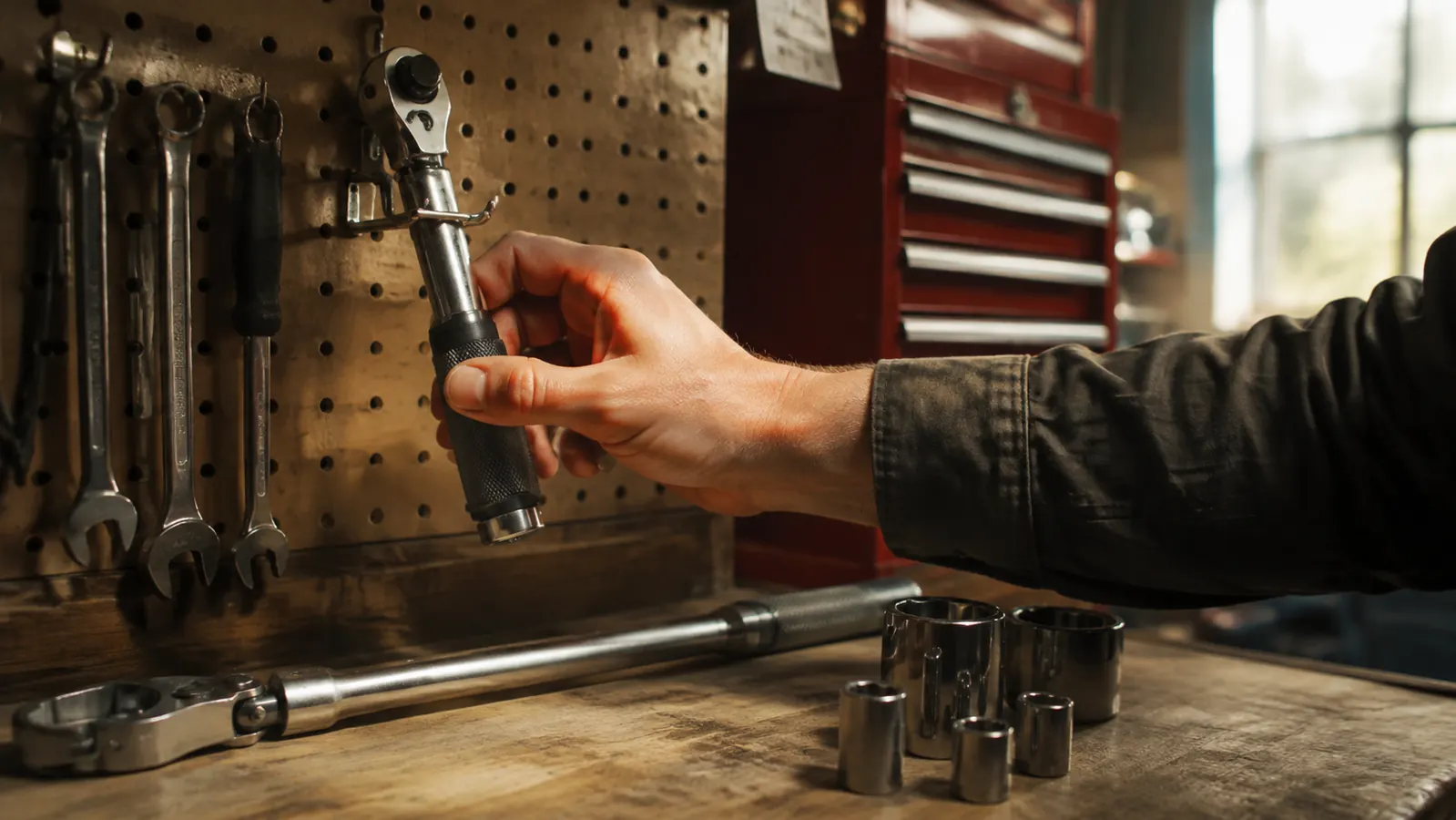
Now the honest con. This is a 1/2-inch drive wrench, and that is the right answer for the upper half of its range, but it is clunky for the small fasteners that dominate a build. A half-inch socket on a 6mm cover bolt is like showing up to a wristwatch repair with a pipe wrench. It fits where it fits, and it is clumsy everywhere else.
You will want a 3/8 inch click wrench sitting right beside the LEXIVON for all the little hardware. That is not a flaw unique to this product, it is the nature of drive size, but it is exactly the thing the five-star reviews leave out. Budget for both, or you will find yourself holding a half-inch wrench on an inlet bolt and wishing you had bought smaller. The LEXIVON is the big-beef half of a two-wrench setup, not the whole setup.
To be fair to the tool, that is not really its fault. A 1/2-inch drive is a 1/2-inch drive, and the design choice to make this a half-inch wrench is why it can reach 150 foot-pounds at all, which is what you need for axles and big-rig hardware. No single wrench is the whole answer on a mixed job. The point I am making is that if your bench is a pile of motorcycle parts, plan on owning two wrenches and let the LEXIVON be the heavier one. The reviews would have you believe one tool does everything, and that is the part of the pitch that does not hold up.
What It's Actually Worth on a Motorcycle Build
Set the marketing aside and this is what you are actually getting. A 1/2-inch drive click wrench that covers 10 to 150 foot-pounds honestly at the low end, with a clear mechanical release and a solid collar. On a motorcycle build that covers engine covers, cam caps, clutch, calipers, triple clamps, sprocket nuts, and axles, which is nearly every number a factory manual prints. It is the single wrench that stays in my hand for the heart of the work.
The length is honest for the range. It has enough leverage to reach 150 foot-pounds without feeling like you are swinging a sledge, and you are not fighting a flexy handle at the top of a sticky axle nut. The knurl keeps a gloved hand planted. It is not a machine-shop-grade instrument and nobody should pretend it is, but for a home builder it behaves so far above its price that the value math is not close. I keep coming back to that: for what it costs, the LEXIVON punches well past its weight class on the one thing that matters, which is a click you can trust.
What I Liked
- Firm, positive click you feel as much as hear, even down around 14 foot-pounds
- Best value 1/2-inch click wrench in its range for a home builder
- Knurled collar with clean detent, so settings hold without creeping
- Reversible head that stays tight after months of use, not sloppy like budget ratchets
Where It Falls Short
- A hard drop can drift the calibration, and there is no way to see it without checking
- 1/2-inch drive is clumsy on the 6mm and 8mm hardware that dominates a build, so you still need a 3/8 inch wrench
- No case included, so it collects dings bouncing around a drawer or box
Who This Is For
If you are building or maintaining your own motorcycle, torquing engine covers, triple clamps, calipers, axles, and anything else the manual prints a number for, this is the wrench to start with. It behaves well enough to teach you the habits a good builder has: wind it to zero when you are done, keep the spring at rest, never use it to break things loose. If you pair it with a small 3/8 inch wrench for the tiny hardware and you do your part on the care side, the LEXIVON will hold its setting for a long, long time. It is the first tool I hand a friend before their first top end.
It is also a genuinely good buy if you are just stepping up from trusting your wrist, because the learning curve is short. The click is clear enough that it teaches you the feel of a correctly torqued fastener instead of fighting you. You will know the moment you have it right, and after a season of using it you will not want to go back to guessing. That is worth more than any spec sheet, and it is the reason this one, among all the cheap options, is the one I keep recommending to people who ask what to buy before their first build.
Who Should Skip It
If your work is almost entirely small 6mm and 8mm aluminum hardware, buy the 3/8 inch wrench first and only come back to a half-inch when a build needs the bigger numbers. If you are the sort who drops tools and expects them to shrug it off, be aware every drop is a calibration event you have to verify. And if you torque the same fastener fifty times a day in a production shop, a digital wrench with a readout treats you better. For a home builder who respects the tool, the LEXIVON is the right call and the best value for the money.
Buy it for the low-torque honesty, and respect the drop.
The LEXIVON LX-183 is the best-behaved click wrench in its price class, as long as you store it right and verify it after a knock. Check today's price on Amazon and put it on your bench.
Amazon Check Today's Price on Amazon →