

If you own a motorcycle for more than one winter, you already know the spring ritual. You walk into the garage, thumb the starter, and get nothing but a click you can feel in your teeth. The Battery Tender Junior is the little box that is supposed to end that. And it does, mostly. But after two winters with the things bolted to five bikes that range from a 1979 CB750 to a twin-cam bagger, there is a version of this product that the 50,000 five-star ratings do not tell you about.
I keep coming back to the Battery Tender Junior because it works for the job it is actually built for. The problem is that almost nobody buys it for that job. They buy it to revive a battery that is already stone dead by spring, and that is a different conversation entirely.
The Quick Verdict
The best small maintainer for a healthy battery that sits all winter. It is too slow and too small to rescue a battery that is already dead.
Amazon Check Today's Price →The Little Box That Keeps 5 Bikes Ready to Crank
If your battery holds a charge and just needs to not lose it over the winter, the Battery Tender Junior is the one that has never failed to keep one of my bikes ready to fire. Check today's price before you order your battery a second time.
Amazon Check Today's Price on Amazon →How I've Used It
I run the Battery Tender Junior on a rotating setup through the shop. The bagger sits on one full-time from October to April because it is a pain to get to and I refuse to buy a battery for it every spring. A 2001 sportbike gets one on a timer when it is not being ridden. The old Honda, the little dual-sport, and a bobber I built two years ago all share a couple of Juniors on a power strip, swapping as I work on whichever one needs to stay ready. Two full winters, five bikes, and I have replaced exactly one battery in that time, on the bike that saw the least use of the tender.
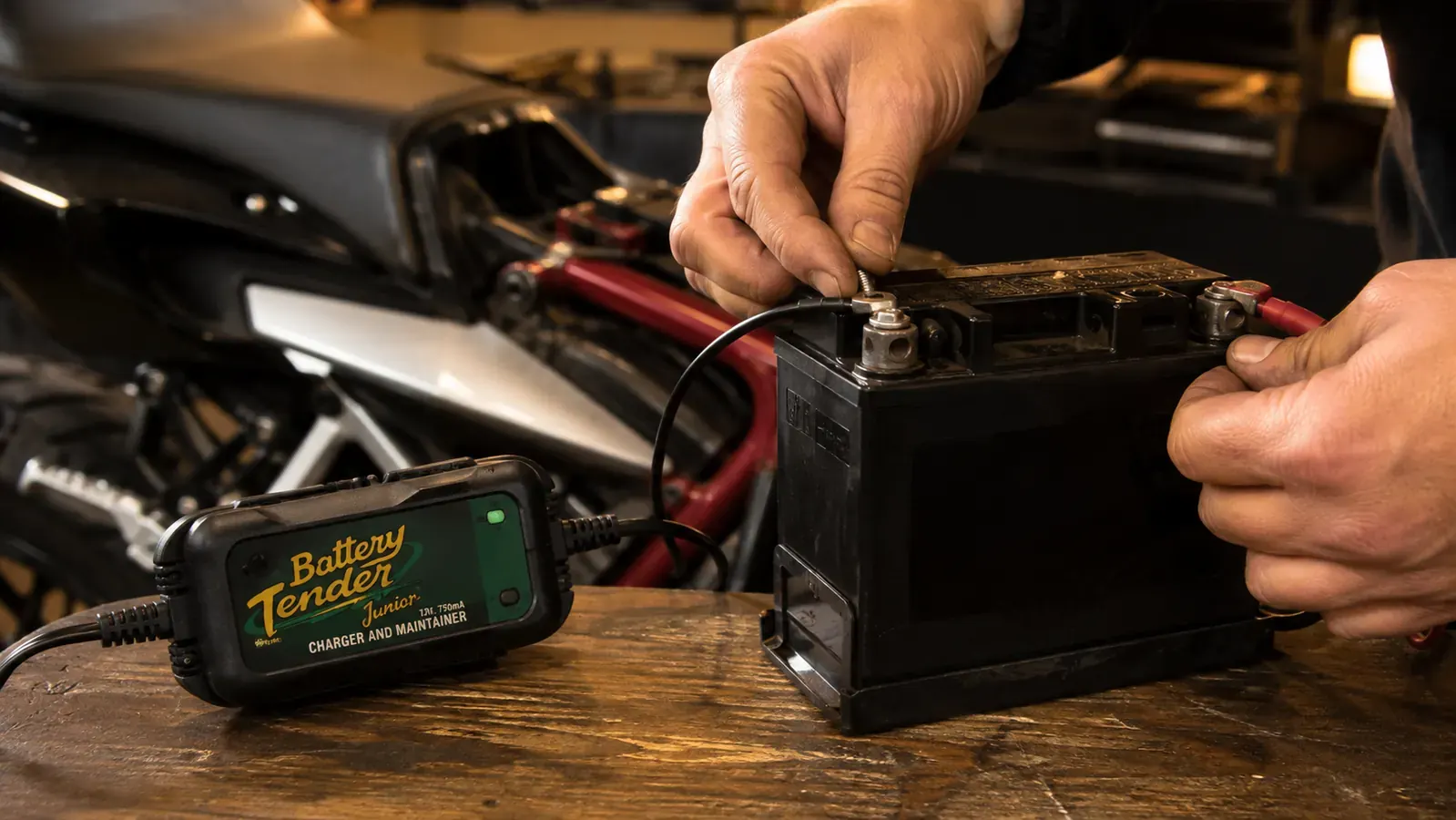
The way the Junior works is simple and it is the reason it lasts. It is a 750 milliamp automatic maintainer. When the battery is full, it drops to a float charge that holds the voltage without cooking the plates. When the battery dips, it tops it back up. It is not a charger and it is happy to tell you so. The light on the front goes solid green when it is maintaining and blinks when it is actively charging. That is the whole interface, and I mean that as a compliment.
The thing I appreciate most after two winters is how little it asks of me. I wire the pigtail once, usually in the fall when I do the oil and the last cleanup, and from then on the winter routine is plug it in on a cold night and forget it. No timers, no worrying about leaving it on too long, no checking water levels every week. The automated float simply does the bookkeeping for you. That quiet reliability is the whole reason it has earned a permanent spot on my bench, and it is worth being clear about before I start in on the limits.

The 750mA Ceiling Nobody Mentions
Seven hundred fifty milliamps is a hair under what a typical 12V battery needs to charge overnight. For a maintainer, that is fine. It is the whole point. The Battery Tender Junior is not built to put meaningful current into a battery; it is built to hold a full battery at full. The problem comes the moment you get greedy and treat it like a charger, which is what the box's own marketing hints at with its charger-and-maintainer label.
I tested it on the battery I pulled off the bobber when it would not hold a charge. The battery was at about 10.5 volts, which is dead enough that most bench chargers refuse it and a couple of the smart ones just call it garbage. The Junior clicked on, blinked its red light for a while, and over about fourteen hours brought it up to a reading that would start the bike. But it will not run a desulfation cycle and it does not have the current to push through a battery that has been sitting under 10 volts for months. On a battery that deeply discharged, the Junior will nurse it along for days and still land you at a battery that cranks weak and dies under load.
So here is the honest split. If your battery held a charge in the fall and you just need to keep it that way through the spring, the Junior is more than enough and it has never let me down. If your battery is already dead when you plug it in, you are asking a 750mA box to do a job a proper 2-amp charger or a battery replacement does better. Read the box like a maintainer, not a charger, and the disappointment disappears.
The Indicator Light Is Smarter Than It Looks
Before I move on from the ceilings, one note on that little lamp, because it is doing more than you think. When you first plug the Junior in, the red light comes on and the unit starts a bulk charge to bring a low battery back up to a safe floor. Once it has enough volts, it eases into the green state and holds the battery at float. If the red light stays on for a very long time, that is your first honest clue the battery is too far gone for 750 milliamps to bring back, and it saves you from waiting on a lost cause.
A lot of people read that stubborn red light as a broken box and leave a bad review. It is not broken. It is the Junior telling you exactly what I told you a paragraph ago: this battery needs a real charger, not a maintainer. Learning to read that light has saved me more time than any other single thing about the device. It turned a two-week waiting game into a five-minute diagnosis.
The Cable That Never Comes Off
The Junior ships with two ways to hook up. There are the two alligator clips for an emergency clamp, and there is the ring-terminal lead that you are actually going to use if you are smart. That ring-terminal lead bolts to the battery posts and then the charging lead plugs into it with a little connector. It works, and it is the clean way to keep a battery maintained without crawling around under the tank every ride.
What the reviews do not dwell on is that ring-terminal lead decides to live on your battery forever. On every bike where I left it installed, the Battery Tender pigtail became a permanent resident. That is fine on a bike that only comes out in good weather. But on a daily rider or a bike that sees rain, the exposed eyelets and the connector are one more set of terminals to corrode, and they are tucked exactly where water and road grime like to collect.
My fix is simple and I do it on purpose: I put the quick-connect pigtail on the bikes that sit, and I pull it off the bike I ride the most. It takes fifteen seconds to unplug and it keeps the terminals clean. The Junior's cable itself is also shorter than I would like, around five feet, so on a big frame the plug does not always reach where you want it. You either buy the extension or you route the pigtail and the unit to the same spot. Minor, but it is the kind of thing that only shows up in the second month of use.
The Junior did not revive the battery I killed. It kept the five healthy ones from dying in the first place. Those are two different jobs, and only one of them is this box.
What It Handles and What It Won't
Stick to the Junior's lane and it is damn near perfect. Motorcycle batteries, ATV batteries, lawn mower cranking batteries, snowmobile batteries, all the small 12V stuff a shop like mine is built around. It runs on standard house power, it is small enough to sit on a shelf, and the auto float means you can leave it plugged in for the whole season without cooking a battery. I have had a Battery Tender Junior on the bagger since October and the voltage reads clean every time I check it.
The lane it should not be in is bigger batteries. It will top off a small car battery in a pinch, but I would not leave it on a big truck battery and expect it to do real work. It is a 750mA device; it is not going to bring a dead semi battery or a cold-crank rig battery back from anything but a light discharge. For the big stuff I own a proper 6-amp charger that does desulfation, and that is the right tool. The Junior is a maintainer, and the moment I remember that, everything about it makes sense.
One more thing worth flagging that the five-star count hides: the Junior is at its best on batteries that are already in decent shape. It does not repair a tired battery, it only keeps one from getting tired. If you plug one in and expect it to turn a three-year-old battery that has been through a few deep winters back into a fresh one, you will be disappointed. Think of it as the difference between changing your oil on schedule and trying to fix a motor that already spun a bearing. The Junior is the schedule, not the rebuild.
What I'd Consider Instead
The closest real competitor is the NOCO GENIUS1, which sits at a similar price point and does add a couple of things the Junior does not: it supports 6-volt batteries and it runs a proper desulfation mode. If you have an old bike on a 6V system, that alone is reason to look past the Junior, because the Junior is 12V only. I keep both in the shop and they are both good boxes, and my comparison article goes point by point through where each one earns its shelf.
Where the Battery Tender Junior still wins for me is simplicity and track record. It has been made for a long time, parts and the pigtail leads are everywhere, and I trust that float circuit with a battery I do not want to think about for six months. The NOCO is more feature-rich and I would not argue with anyone who buys one. But for a 12V bike that sits, the Junior does the one job the most reliably, and that is the whole reason it has fifty thousand reviews.
What I Liked
- Keeps a healthy battery sitting all winter with zero loss
- Simple, set-and-forget float circuit
- Small, cheap, proven, and everywhere in stock
- Ring-terminal pigtail makes hookup a permanent clean connection
- Safe to leave plugged in for months
- Solid green and red state lights tell you exactly what it is doing
Where It Falls Short
- 750mA is too slow to revive an already-dead battery
- No desulfation mode
- 12V only, so it is useless for a 6V bike
- Permanently attached pigtail corrodes if left on a rider
- Short cable on big frames needs an extension
Who This Is For
If you have one motorcycle, or three, and you park them for more than a week at a time, the Battery Tender Junior is a no-brainer. It is for the guy who rides in the summer, moans at the battery in the spring, and wants a cheap habit to never have that spring again. Park the bike, plug in the tender, ride next season. That is the use case this box was built for and it nails it every single time.
It is also for the guy who has a project bike that sits for months between bench sessions while he collects parts. Getting a project to fire after it has sat is the single most common reason a built bike ends up in a corner. The Junior, on the battery for the whole build, means the thing has crank when you finally put it back together. That alone is worth what the Junior costs at current pricing.
Who Should Skip It
Skip it if your battery is already dead when you reach for a tender. If you are buying this to bring a battery back that read 9 volts in March, you are going to be disappointed, and the battery may be past saving regardless of what you plug into it. Buy a proper charger with desulfation, or just replace the battery, and keep the tender for next winter's healthy battery.
Skip it if you only have a 6-volt electrical system, because the Junior will not touch it. And skip it if you are carrying a car or truck battery through a deep winter and expect a 750mA maintainer to do real work on it. It will help a healthy big battery hold charge, but it is not the tool for bringing one back. Match the box to the job and you will be happy; use it for the wrong job and you will be the guy writing a one-star review that blames the product for your battery.
Winter Is Coming. Your Battery Does Not Have To Know.
Two winters, five bikes, one battery replaced, all the others cranking clean in spring. If any of your bikes sit for more than a week, the Battery Tender Junior is the cheapest insurance in the garage. Check today's price and stop buying batteries every other season.
Amazon Check Today's Price on Amazon →