

Here's the short answer so you don't have to scroll: if you've got a bike or a four-wheeler that just needs to sit and stay charged through a long winter, get the Battery Tender Junior. If the battery is already sulfated and won't hold a charge, or you're nursing something old with a 6V system, get the NOCO GENIUS1. Both are small 12V maintainers that sell for about the same money, and both will keep a healthy battery topped up all season. The honest difference is which job each one is actually best at, and that matters more than the name on the box.
I keep five bikes in various states of build, and for years the only maintainer in the shop was a Battery Tender Junior. It's the box on the shelf of every dealership and parts shop for a reason. But once I started dragging home old 6V machines and a couple of batteries that had sat too long to trust, I picked up the NOCO GENIUS1 to see if the newer tech was worth the switch. After a full season running both in the same garage, I'm not replacing one with the other. They cover different ground, and a shop that keeps old iron alive probably wants both on the bench.
| Battery Tender Junior | NOCO GENIUS1 | |
|---|---|---|
| Voltage support | 12V only, so it only covers modern cars, bikes, and toys | Handles 12V and 6V, so it reaches old bikes, vintage rigs, and small engines |
| Reviving a dead battery | 750mA of gentle current, ideal for maintaining a good battery | 1 amp plus aggressive desulfation and a recondition mode that can bring a sulfated battery back |
| Hardwired fitment | Ring terminals bolt to the battery and the quick connector tucks under the seat, bike ready to plug in all winter | Smart clamps are fine on a bench, but you buy the eyelet kit separately to hardwire it the same way |
| Brand infrastructure | Decades on dealership shelves, and its quick-connect accessories are everywhere | A newer brand with far less of an installed base of accessories behind it |
| Cables | Cable is permanently attached, one less thing to lose but less tidy to store | Detachable cables and clamps, a cleaner setup and easier to swap leads |
| Best for | A bike that sits between rides and needs to crank when you want it | An already-sulfated battery or an old 6V machine you're trying to coax back |
How I Ran Both Through a Winter
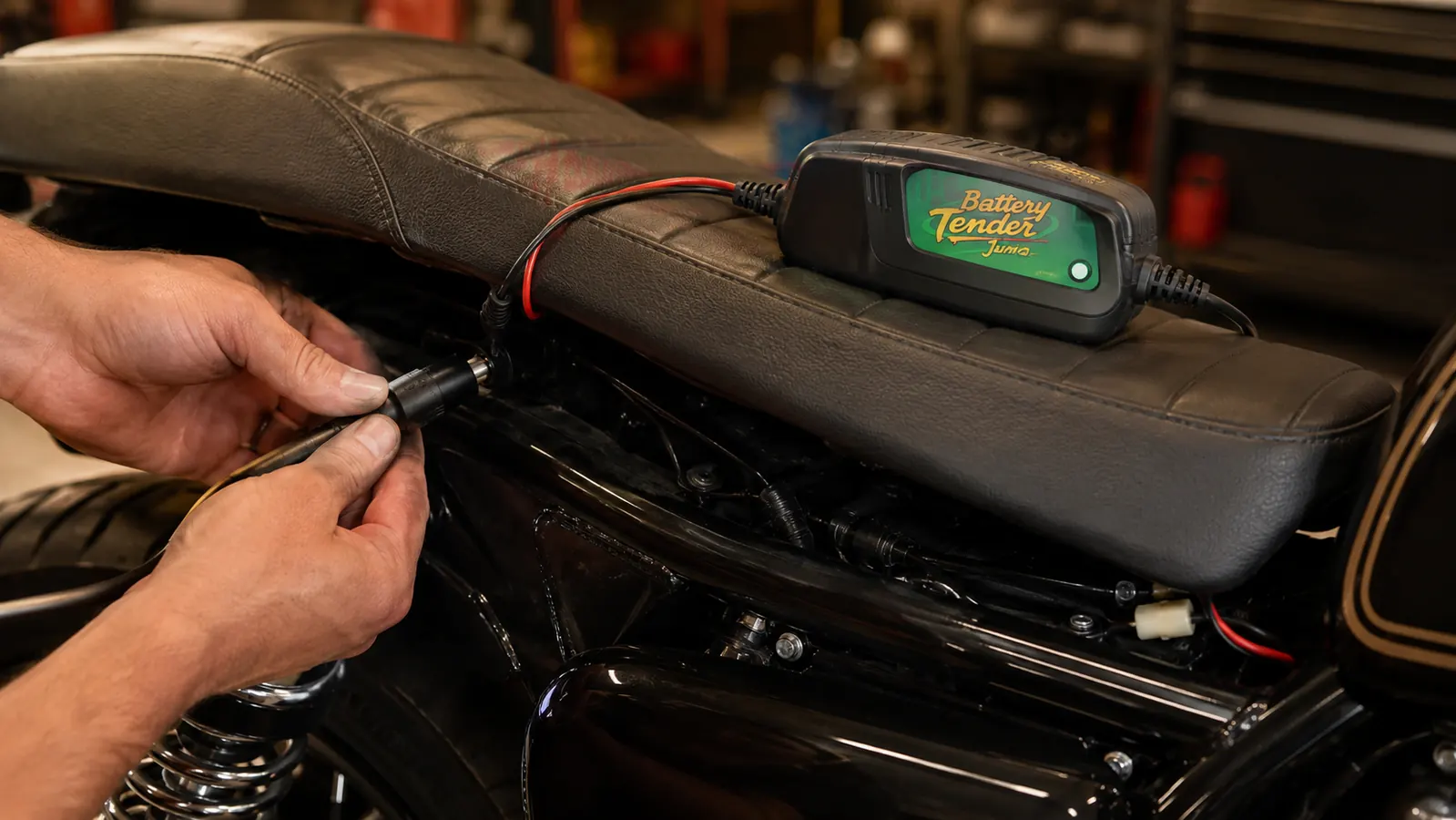
Before I put a single number in that table, let me tell you how I actually used them, because that's where the real story lives. I hardwired the Battery Tender Junior to my daily rider, my 2014 Yamaha that I ride all season and park for the worst of winter. The ring terminals went on the battery posts, the quick-connect harness ran out from under the seat, and the round connector tucks tight against the frame where nothing snags. When I parked the bike in November, I plugged in the Junior and didn't touch it again until March.
The NOCO GENIUS1 went onto a 1980s dual-sport that I bought as a basket case. Its battery was flat in the way that makes you assume it's toast, the kind that reads a sad voltage on the meter and won't take a charge from a regular charger without blinking into fault. I clamped the NOCO on, set it to the recondition cycle, and let it run. Over a couple of days it pulled the cell back to a point where it actually held a charge, and the bike cranked over for the first time in years. That is not something the Junior would have managed on its own.
So my honest take across a season is that they're not really competitors in the way most comparison charts pretend. They're two tools for two situations, and the reason this argument keeps coming up is that most riders only want to buy one and are annoyed that both are worth having. I'll walk you through exactly where each one earns its spot.
Where the Battery Tender Junior Wins
The Junior's biggest edge is the way it fits a motorcycle, not the way it charges one. Out of the box you get a set of ring terminals that bolt straight onto the battery posts and a quick-connect harness you can leave permanently attached. I ran that harness under the seat of my daily rider and tucked the round connector where I can reach it without tools. In November I plug in the Junior, in March I unplug it and the bike lights up first try. That's the whole job, done without breaking out a wrench to clamp alligator leads onto a terminal every single week.
The other thing the Junior has going for it is sheer ubiquity. When I wear out a set of clamps or lose a quick-connect, I can buy a replacement at a dozen places without waiting on shipping, and the accessory connectors match the ring terminals I already hardwired. There's real value in a standard that everyone else builds around. For the bikes that just need to stay topped up, that convenience is worth more than a few extra milliamps of current. It's the box I'd hand to somebody who wants a maintainer they never have to think about, which is most people with a bike that goes in the garage for the season.
There's also a comfort factor you pick up after a decade of using one. The Junior is boring in the best possible way. It sits there, its light glows, your battery stays at full voltage, and nothing ever draws your attention to it. I've had two of them running essentially nonstop for years across bikes, an ATV, and a generator battery, and I've never had a Junior fail on me or cook a battery. That track record counts for a lot when a maintainer's whole job is to be uneventful.
Now let me be honest about where the Junior gives ground, because pretending otherwise does nobody any favors. At 750mA it is a maintainer, not a resurrection tool. If a battery still has decent life in it, the Junior tops it up and holds it all winter without complaint. But if the voltage has sagged below where it can work with, the Junior just sits there with its light doing nothing useful. I've watched it throw itself into a cycle on a flattened battery and make zero progress over a full day. That's not a defect, it's the design, and knowing it up front keeps you from expecting the wrong thing from the box. If your battery is already past the point of no return, the Junior will hand you a meter reading that hasn't moved.
Where the NOCO GENIUS1 Wins
The GENIUS1 wins everywhere the battery is already in trouble. A Battery Tender Junior assumes you're starting with a decent battery and just keeping it healthy. The NOCO is built to bring a battery back from the dead. Its recondition mode pushes a higher voltage in steps to break up the sulfate crystals that form when a battery sits flat, and I've had it revive a battery that another maintainer just bounced the charger light on. On a bike that hasn't cranked in three years, that difference is the whole ballgame.
The 1 amp rating versus the Junior's 750mA matters more than the numbers suggest when you're starting from a deeply discharged battery. It gets a flat battery up to a voltage where the smart charging logic will take over, which is the hurdle that keeps a weaker charger stuck in fault. And the 6V support is a genuine differentiator if you own anything from the era before 12V became the standard. Between an old 6V bike and the occasional vintage snowmobile, that's a real reason to keep one in the cabinet even if the daily rider never needs it.
Let me give you a concrete example instead of a spec sheet, so you know I'm not just reading the box. Last winter a neighbor hauled over a barn-find that had sat for the better part of a decade, its battery reading 4.9 volts on my meter and refusing to take a charge from anything normal. I clamped the NOCO on, let its recondition cycle run in steps, and two days later that same battery held north of 12.5 volts under a load and kicked a cold engine over for the first time in years. I'm not going to tell you every flat battery comes back, some are genuinely cooked and no box will fix chemistry that's gone, but it's the only charger in my drawer that even tries, and it's pulled back more than one battery I'd already written off. That's the whole difference between a maintenance tool and a revival tool, and the NOCO is the latter.
Its newer smart-clamp design is a genuine safety improvement too. The clamps are spark-proof, so you don't get that little arc when you clip onto a battery that's sitting at full voltage. The leads clip on in either order without fuss, and the whole setup rejects reverse polarity. If you've ever burned a clamp or startled yourself with a spark while hooking up a charger in a dark garage, you'll appreciate that. The NOCO is the more technically capable box, full stop. I just wouldn't pick it as the primary maintainer for a healthy bike that sits.
The NOCO is the more technically capable box, full stop. I just wouldn't pick it as the primary maintainer for a healthy bike that sits.
If you've got a bike that sits, the Junior is the one you plug in and forget
A decade of riders have trusted the Battery Tender Junior to keep their battery ready through long storage. Fasten the ring terminals once, tuck the harness under the seat, and it keeps your bike topped up all winter. Straightforward, proven, and built around the accessory standard every shop stocks.
Amazon Check Today's Price on Amazon →
The Finer Points Nobody Mentions
There are a few small things that don't make the spec sheet but decide how pleasant these are to live with. The Junior's cables are permanently attached to the little black box, which means fewer loose pieces to lose but a less tidy setup to store, because you can't unplug the leads and coil them up separately. The NOCO's cables detach, so you can tuck the box away and keep the clamps in a drawer if you want. Neither is a dealbreaker, but it's the kind of thing you notice the third time you're shoving a charger into a tool bag.
Both boxes are small enough to sit on a shelf without eating the whole bench, and both have an indicator light that tells you when the battery is charged. Neither is going to argue with you about whether the battery is connected, the way some bulkier chargers do. And honestly, for the money they both cost about the same at today's prices, so price isn't the deciding factor between them. What you're really choosing is which failure mode you're preparing for: the bike that just needs to stay alive, or the battery you're trying to rescue.
Who Should Buy Which
One thing I want to flag before you pick sides: neither of these boxes is meant to charge a battery the way a bench charger does. They hold voltage and add a small top-up, which is exactly right for a bike that sits. If you expected either one to recover a fully dead battery overnight, you'd be disappointed in both, because that's not what a maintainer is for. The NOCO gets closer to revival work with its recondition cycle, but even it works in steps over days, not minutes. Set your expectations before you buy and you won't be chasing a battery that a proper charger should have handled.
There's also a practical wrinkle about the hardwired Junior worth knowing before you commit. Once those ring terminals are bolted on and the harness is tucked under the seat, that bike is tied to Junior's quick-connect standard unless you buy an adapter. That's fine if you ride one bike, but if your garage rotates through several machines, the NOCO's detachable clamps are easier to move from bench to bench without leaving hardware on every battery. It's a small thing, but it decides which one lives on the tool wall and which one stays in the parts drawer.
If your garage looks like mine, with a bike you ride all season that sits between weekends, the Battery Tender Junior is the right call. You want something you can hardwire once, plug in when you park it, and forget until you're ready to ride. That's exactly its lane, and the accessory network means you're never hunting for a replacement part. If you only buy one maintainer and you've got a reasonably healthy vehicle to keep alive, get the Junior. If you're on the fence knowing your riding pattern, that's the answer: the one you'll actually plug in without fuss is the one that does the job.
If you're the guy who drags home projects, or you inherited a bike that's sat in a barn, or you own anything with a 6V system, the NOCO GENIUS1 earns the slot next to it. Its desulfation and recondition modes, plus 6V support, make it the better revival tool, and its higher current gets a genuinely dead battery back up faster. The honest way to read this comparison is that they're both worth owning because they solve different problems, and the Junior remains the one I trust to keep my daily rider ready to crank on the first warm day of spring.
Keep every bike in the shop ready to crank with the Battery Tender Junior
The little black box that has kept project bikes alive through a decade of winters. Hardwire the ring terminals, and every bike in your garage is ready to fire when you are. It's the maintainer I plug in and don't think about.
Amazon Check Today's Price on Amazon →